
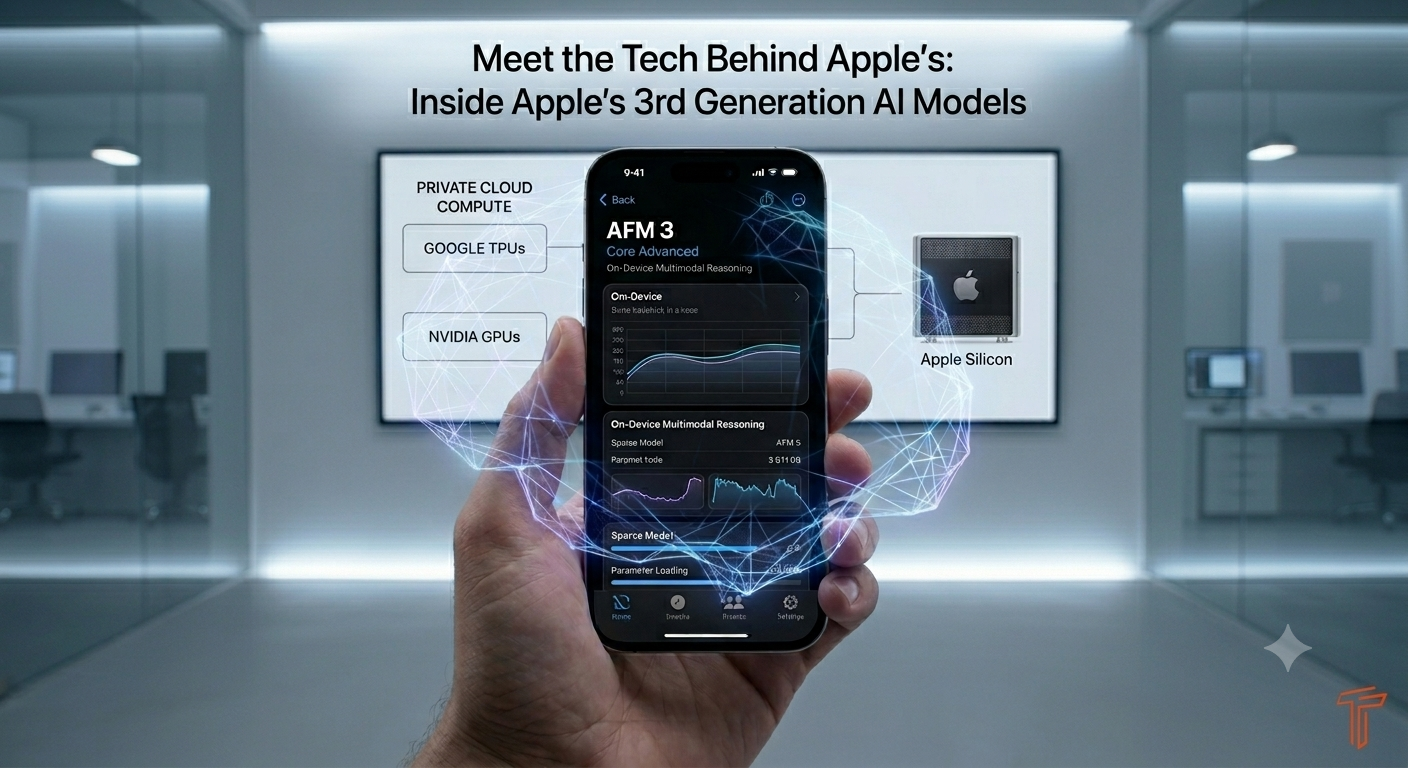
Tech critics whispered that Apple was falling behind in the Artificial Intelligence (AI) race. While competitors launched massive cloud-based chatbots, Apple stayed quiet. But at WWDC 2026, Apple completely changed the narrative. The company unveiled its 3rd Generation Apple Foundation Models (AFM 3), proving that they weren’t lagging; they were just building something entirely different.
Developed in a historic, deep collaboration with Google, Apple’s new AI architecture brings elite-level reasoning directly onto consumer hardware. This article takes you under the hood to explore the brilliant engineering, the family of models, and the privacy-first tech that makes Apple Intelligence the new gold standard for consumer AI.
The Big Breakthrough: Fitting a Giant in Your Pocket
Traditional AI models face a major bottleneck: they require massive amounts of active memory (DRAM) to function. If a model is too big, a smartphone simply cannot run it. Apple’s engineering team broke this barrier with their star on-device model, AFM 3 Core Advanced.
AFM 3 Core Advanced is a 20-billion-parameter model. Normally, a model of this size can only live in a massive data center. Apple managed to make it run locally on an iPhone by using a smart architecture known as Instruction-Following Pruning (IFP).
How Flash Memory Saving Works
Instead of packing the entire 20-billion-parameter model into the phone’s limited RAM, Apple stores the full model inside the phone’s fast Flash Storage (NAND). When you ask a question, a system orchestrator analyzes the query and dynamically selects a subset of “expert” parameters.
It loads only 1 to 4 billion parameters into the active memory at any given time, keeping a core set of shared skills always active. This process allows the device to handle complex, multimodal tasks—like processing voice, images, and text simultaneously—without draining your battery or slowing down your phone.
Meet the AFM 3 Family: Five Models Built for Silicon
Apple didn’t just launch one model; they built a highly coordinated family of five distinct models. Each one is tailored to handle specific workloads, balanced between local efficiency and cloud-based power.
| Model Name | Parameters / Type | Location | Main Purpose |
| AFM 3 Core | 3-Billion (Dense) | On-Device | Quick, everyday tasks like smart text replies and basic notifications. |
| AFM 3 Core Advanced | 20-Billion (Sparse) | On-Device | Complex natively multimodal tasks, advanced dictation, and expressive voices. |
| AFM 3 Cloud | High-Scale Server | Private Cloud | The server-side workhorse built for speed and deeper contextual understanding. |
| ADM 3 Cloud (Image) | Generative Image | Private Cloud | Powers advanced photo-editing, Image Playground, and Genmoji. |
| AFM 3 Cloud Pro | Frontier Reasoning | Cloud (NVIDIA GPUs) | Heavyweight engine for agentic tool use and advanced coding. |
Every single model—with the exception of the Pro version, which runs on specialized cloud hardware—is completely optimized from the ground up for Apple Silicon (M-series and A-series chips).
The Google & Nvidia Connection: A Smart Alliance
One of the most surprising revelations about the 3rd generation models is the deep engineering partnership between Apple and Google. While Apple designed the core user experience, these AFM 3 models were custom-built utilizing Google’s advanced infrastructure and technologies behind the Gemini family.
Furthermore, Apple trained these models using Google’s Cloud TPUs (Tensor Processing Units). For the absolute highest tier of processing—the AFM 3 Cloud Pro—Apple collaborated with both Google and Nvidia to extend its strict privacy system onto high-performance Nvidia GPUs. This unique partnership gives Apple users access to world-class “frontier” AI muscle without sacrificing Apple’s signature ecosystem control.
Real-World Impact: What These Models Actually Do
This complex engineering isn’t just for show. It translates directly into features that solve daily digital friction. Under the power of AFM 3, the completely redesigned Siri AI transforms from a simple voice-command system into a proactive agent.
1. On-Screen and Personal Context Awareness
Because the new models are natively multimodal, Siri can look at your screen and understand what is happening. If a friend texts you details about a dinner plan, you can simply say, “Siri, look up recipe ideas based on this text and save them to my Notes.” The system orchestrator coordinates the data across apps flawlessly.
2. Next-Level Spatial Photo Editing
In the Photos app, the ADM 3 Cloud image model introduces high-end spatial capabilities. Using data principles learned from the Apple Vision Pro, users can now select an object in a photo and drag it to shift the camera’s visual perspective after the picture has been taken. The AI seamlessly fills in the newly empty backgrounds. Additionally, any image modified by these tools automatically embeds a hidden SynthID watermark to guarantee digital transparency.
3. “Describe a Shortcut” System Automation
Automating tasks on an Apple device used to require manual programming in the Shortcuts app. Now, you can just write down what you want in plain English: “Turn on my porch lights when I get a food delivery notification.” The underlying AI reads your text, locates the correct apps, and builds the entire multi-step automation script on your behalf.
Privacy at Its Core: Private Cloud Compute
The biggest worry with modern AI is data security. Sending personal text messages, photos, and live schedules to a cloud server feels incredibly unsafe to most users. Apple’s architecture solves this through its Private Cloud Compute (PCC) stack.
When you make a request, the on-device system tries to process it locally using AFM 3 Core or Core Advanced. If the task is too heavy, it encrypts the data and sends it to Apple’s custom cloud servers running on Apple Silicon.
The Privacy Promise: Data sent to Private Cloud Compute is used solely to execute your immediate request. It is never saved, never stored, and Apple cannot read it. To prove this, Apple makes the entire blueprint and code logs of these servers completely open so that independent security experts can inspect and verify their claims at any time.
Expanding the Ecosystem: Developer Flexibility
Apple is also using this 3rd generation launch to make its ecosystem friendly for developers. A new native Swift API called the Foundation Models Framework allows third-party app creators to plug into these advanced models with just a few lines of code.
Even more interesting is Apple’s new model-abstraction layer. Recognizing that users want options, Apple has allowed developers and users to easily integrate external third-party models like Anthropic’s Claude or standard Google Gemini into the workflow. If a user prefers an alternative assistant, iOS 27 even permits them to set a rival AI model as their default core assistant.
Conclusion
The 3rd Generation of Apple Foundation Models represents a massive leap forward for consumer technology. By focusing on hybrid processing—running lightweight, highly intelligent sparse models on local chips while keeping heavy tasks safe inside Private Cloud Compute—Apple has proved that AI can be immensely powerful without being invasive.
Through clever engineering like Flash-memory model streaming and strong strategic partnerships with Google, Apple has successfully built an AI architecture that doesn’t just chat with you; it safely understands your world.


