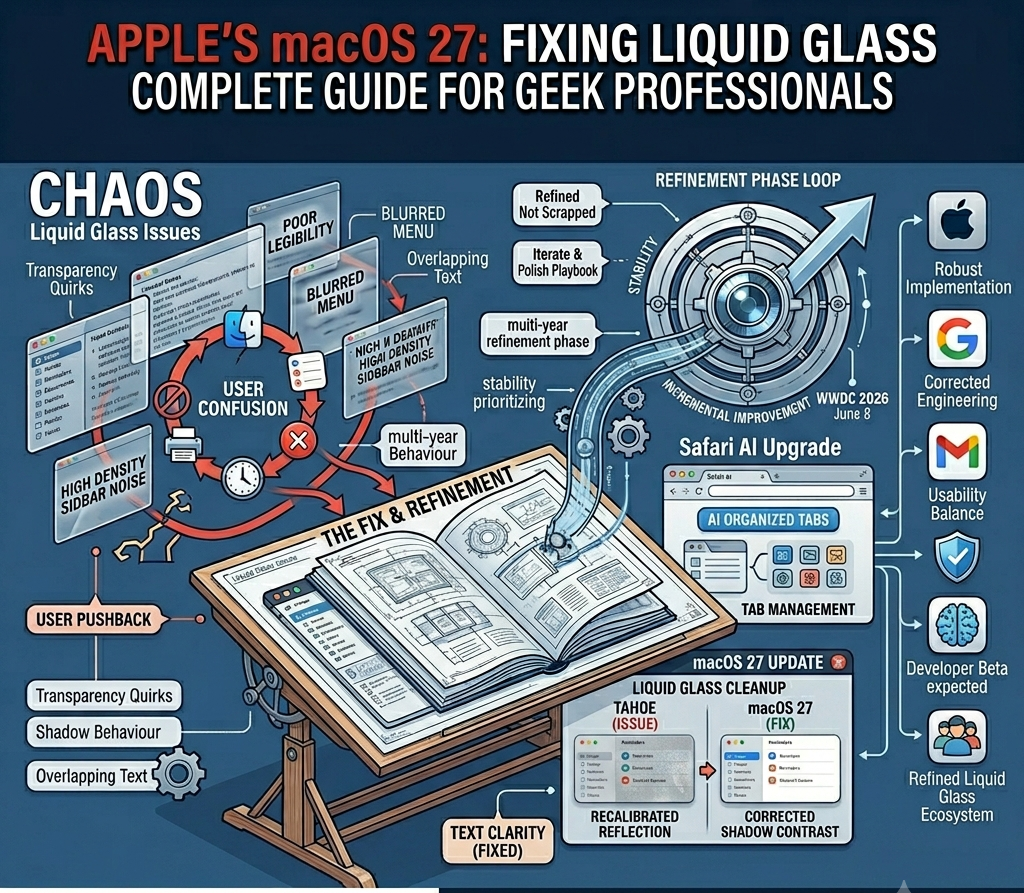
Apple is finally listening. After months of widespread criticism over its bold Liquid Glass design language. The company is preparing meaningful visual improvements for macOS 27, set to be unveiled at WWDC 2026 on June 8. The changes won’t scrap the controversial interface, but they will address the real-world usability problems that frustrated Mac users ever since macOS Tahoe shipped last year.
What Is Liquid Glass and Why Did Users Push Back?
Liquid Glass is Apple’s most ambitious design overhaul since the flat design era introduced with iOS 7 back in 2013. The interface added glass-like layering, refraction effects, floating menus, and dynamically reflective UI elements heavily inspired by visionOS. While it looked polished in product demos, the reality on everyday Mac displays told a different story.
The transparency and shadow effects did not translate cleanly across the Mac’s mix of LCD and OLED displays. Menus became harder to read, and Control Center panels blended into backgrounds. Dense sidebars added visual noise that genuinely hurt usability.
The complaints were loudest among users running macOS Tahoe on non-OLED Macs.
Which still make up the vast majority of machines in active use today.
What Apple Is Fixing in macOS 27
According to Bloomberg’s Mark Gurman, Apple is preparing a “slight redesign” for macOS 27, specifically fixing shadows and transparency quirks.
In areas featuring sidebars or dense concentrations of text, Liquid Glass textures reduce text clarity or create interface confusion.
The redesign is described as making Liquid Glass look the way Apple’s own design team originally intended, rather than the version that shipped with Tahoe.
Apple is recalibrating how reflective surfaces, shadow contrast, and overlapping transparency behave in apps like Finder and Reminders.
Importantly, Gurman’s sources inside Apple frame this less as a design failure and more as an engineering one. The changes are meant to correct a “not-completely-baked implementation from Apple’s software engineering team,” not a flawed design direction.
That distinction matters. Apple is not admitting it went the wrong way, but it is acknowledging that the execution fell short.
Liquid Glass Is Here to Stay
If you were hoping Apple would roll back to its pre-Tahoe aesthetic, that is not happening. Despite the criticism, Apple does not intend to do away with Liquid Glass or make any radical changes to it in macOS 27. The goal is described as a cleanup and refinement effort, not a wholesale visual reset.
This cleanup approach is not unusual for Apple. After the iOS 7 redesign in 2013 introduced flatter interface elements, Apple spent the following year refining the software with iOS 8. macOS 27 appears set to follow that same playbook, iterate and polish rather than retreat.
Safari Gets an AI Upgrade Too
The macOS 27 story goes beyond design fixes. Safari is gaining an AI-powered “Organize Tabs” feature, accessible via a new center-top button, letting users group tabs automatically or on demand.
This brings intelligent tab management to Mac users in a way that feels native rather than bolted on, a meaningful productivity upgrade for anyone juggling dozens of open tabs.
What to Expect at WWDC 2026
Apple will reveal iOS 27, macOS 27, and other OS updates at WWDC 2026 on June 8, with developer betas expected immediately and public betas arriving in July.
The broader “27” software lineup is shaping up to prioritize stability, performance, and incremental improvements rather than flashy new features, a deliberate choice after the turbulent Tahoe launch.
By focusing on stability, performance, and incremental design improvements, Apple appears to be entering a multi-year refinement phase rather than pursuing rapid redesigns.
This approach could help balance aesthetics, usability, and accessibility concerns for a wide range of users.
For Mac users who struggled with Tahoe’s glassy excess, macOS 27 may finally deliver the version of Liquid Glass that Apple always intended to ship.